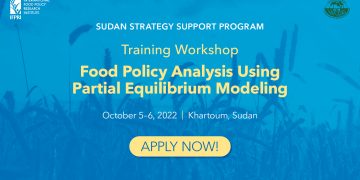
Partial equilibrium models can provide important insights for food policy in the context of shocks to production, household incomes and international prices. Combining estimates of current levels of supply, demand by various household groups and key model parameters describing the responsiveness of supply and demand to changes in prices and incomes, these models help to quantify effects of economic shocks and alternative policy options.
MIDDLE EAST AND NORTH AFRICA LAUNCH AND DISCUSSION OF IFPRI’S 2022 GLOBAL FOOD POLICY REPORT: CLIMATE CHANGE AND FOOD SYSTEMS

The 2022 Global Food Policy Report on Climate Change and Food Systems highlights the urgency of tackling adaptation and mitigation in our food systems to achieve food and nutrition security, sustainability, and other global development goals. The report showcases policy priorities that can — and should — be implemented now
LAUNCH & CO-CREATION WORKSHOP OF THE SUDAN SSP
On Wednesday, February 9th, 2022, IFPRI and USAID hosted a Launch and Co-creation Workshop introducing the new Sudan SSP.
Virtual Event – COVID-19’s Short-term Impacts on Economies, Food Systems and Poverty in African and Asian Countries: Economywide Estimates from Economywide Models
Co-Organized by IFPRI and the CGIAR Research Program on Policies, Institutions, and Markets (PIM) AUG 11, 2020 - 09:30 AM TO 10:45 AM EDT Developing countries responded to COVID-19 by implementing social distancing measures and limiting non-essential business operations. Agrifood systems and food supplies—although generally exempt from restrictions—have been exposed to policy disruptions and global market instability. To measure […]