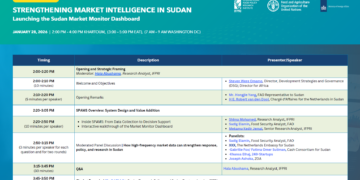
Introduction Sudan is experiencing severe economic and market disruptions driven by prolonged conflict, political instability, and macroeconomic deterioration. These shocks have undermined agricultural production, fragmented supply chains, and destabilized markets, resulting in volatile food availability and affordability with stark regional disparities. In such fragile contexts, timely and granular market information is essential for guiding […]
Research Findings from Fragile Settings and Pathways for Resilience: the case of Sudan
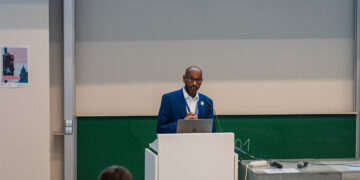
At the Fragile Lives Conference, organized by Humboldt University of Berlin and ISDC, on September 30-October 1, 2025, in Berlin, Germany, IFPRI Sudan’s researchers showcased critical evidence on social protection programming and resilience in Sudan amid conflict. Kibrom Abay (IFPRI, Senior Research Fellow) presented a study on the potential of digital cash transfers to save lives […]
NEW PUBLICATION: Evaluating cereal market (dis)integration in less developed and fragile markets: The case of Sudan
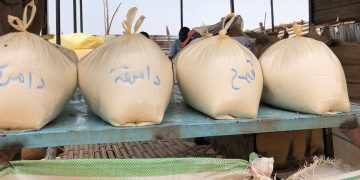
This paper evaluates spatial market integration in cereal markets in Sudan, focusing on wheat and sorghum, two major cereal crops. Sudan’s context provides important insights on the functioning of markets in economies marred by sanctions, conflicts, soaring inflation, and macroeconomic imbalances. We use long-ranging monthly cereal price data and a vector of error-correction cointegration model (VECM) to characterize both short-term and long-term spatial price adjustment across cereal markets
Training Workshop: Food Policy Analysis Using Partial Equilibrium Modeling
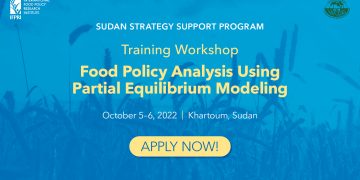
Partial equilibrium models can provide important insights for food policy in the context of shocks to production, household incomes and international prices. Combining estimates of current levels of supply, demand by various household groups and key model parameters describing the responsiveness of supply and demand to changes in prices and incomes, these models help to quantify effects of economic shocks and alternative policy options.
الصراع القائم بين روسيا وأكرانيا وتفاقم مشاكل الأمن الغذائي في السودان

تسبب الغزو الروسي لأوكرانيا في تعطيل الإنتاج الزراعي والتجارة من إحدى أهم مناطق العالم لتصدير المواد الغذائية، وتهدد الحرب بارتفاعٍ أسعار المواد الغذائية المتزايدة بالفعل، وستؤدي كذلك إلى ندرتها، ولا سيما في المناطق الأكثر اعتمادًا على القمح والصادرات الأخرى من روسيا وأوكرانيا – وتحديدًا بلدان منطقة الشرق الأوسط وشمال إفريقيا.